🇺🇸
LAX · North America
- Country
- United States
- Capital
- Washington, D.C.
- Currency
- USD
- Visa for PH
- Visa required (apply via embassy/VFS)
- OFW relevance
- Low — mostly tourism / balikbayan
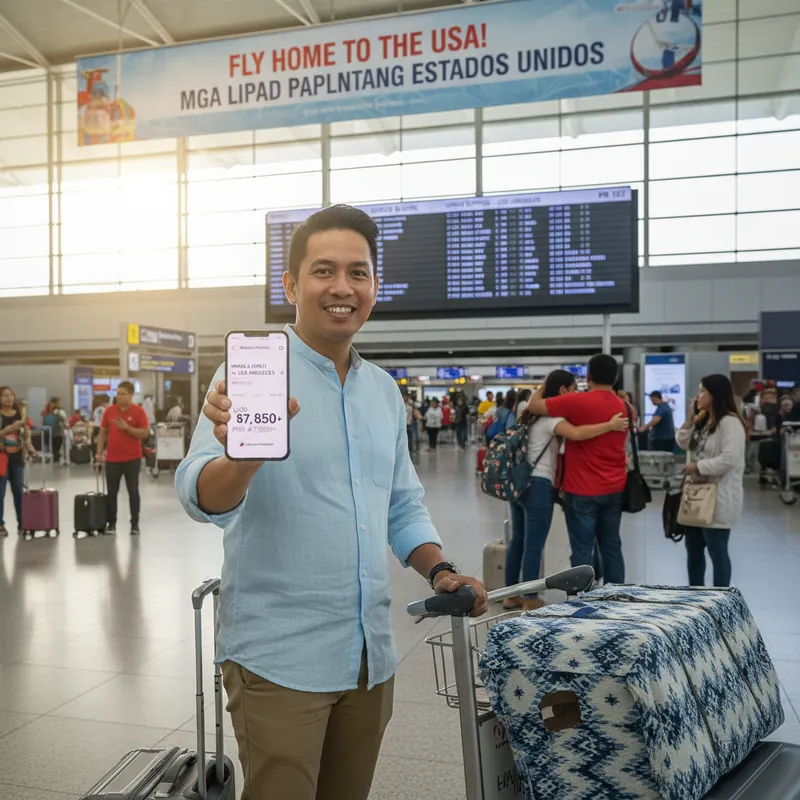
The United States is the largest balikbayan corridor — ~4.2 million Filipinos and Filipino-Americans, the largest Filipino diaspora outside the Philippines. Philippine Airlines dominates with daily nonstop service to LAX, SFO, JFK, plus 5x weekly SEA at planned ORD service. Off-peak roundtrip economy fares sit at PHP 38,000-58,000 (LAX); JFK at SEA climb to PHP 45,000-72,000. Pasko at summer peak hits PHP 85,000-120,000. US visa required for all Philippine passport holders.
Visa for Philippine passport holders
1 primary rule governs entry to United States on a Philippine passport: B1/B2 visitor visa required, $185 USD non-refundable, maximum stay decided at port of entry, typically 6 months. Verified 2026-05-18 against the official source. 7 corridors are catalogued between the Philippines and United States, from 2 Philippine airports.
The United States does not offer visa-free entry for Philippine passport holders — Philippines is not a Visa Waiver Program country. B1/B2 visitor visa ay most common for tourism, balikbayan, at family visits, valid 10 years multiple-entry once approved. Apply via US Embassy Manila with DS-160 form, MRV fee (~USD 185 / PHP 10,500), in-person interview, at supporting documents (financial, employment, ties to Philippines). Approval rates vary by applicant profile; first-time applicants face higher refusal rates. F-1 student visa for university studies. H-1B specialty occupation at EB-2/EB-3 employment-based immigrant visas for sponsored work. Family-based immigrant visas (F1-F4 categories) have multi-year backlogs. K-1 fiance visa for marriage-based migration. B1/B2 holders cannot work, study formally, or stay >6 months per entry. This is general information based on public consular guidance — verify current requirements with the US Embassy in Manila or a licensed immigration attorney. Not legal advice.
Routes from PH airports
7 corridors connect 2 Philippine airports to 5 airports in United States, about 44 one-way departures a week in total. 3 carriers are on file across those corridors.
Origins on file: CEB, MNL. Arrival airports: JFK, LAX, ORD, SEA, SFO. Carriers: Delta Air Lines, Philippine Airlines and United Airlines. What that list implies is more useful than the list itself. Where several Philippine origins reach United States directly, a provincial departure can beat a Manila one once the domestic positioning flight and its hotel night are priced in. Where only Manila has the nonstop, everyone routes through the same building and the same weather, and your connection buffer should reflect that. Count the arrival airports too: more than one usually means the cheap fare goes to the secondary field, and the ground transfer from it is a cost the fare comparison never shows you.
| Origin | Dest | Carriers | Weekly Freq | Block Hours |
|---|---|---|---|---|
| MNL | LAX | PR | 14 | 13.0 |
| MNL | SFO | PR, UA | 12 | 12.5 |
| MNL | JFK | PR | 7 | 16.5 |
| MNL | ORD | PR | 4 | 15.0 |
| MNL | SEA | PR, DL | 5 | 12.5 |
Best time to fly
4 Philippines–United States corridors carry a live fare reading, the cheapest at ₱27,033 one-way. Every reading is a cache floor for a single date and fare class, excluding checked baggage where it is sold separately. 7 corridors are catalogued between the Philippines and United States, from 2 Philippine airports.
Cheapest pockets are late January through March at September to early November, when MNL-LAX dips to PHP 38,000-48,000 roundtrip. Avoid the Pasko balikbayan rush (Dec 15-Jan 5) — pinaka-mahal window of the year, fares spike 80-150% kasi puno ng kabayan visiting family. US summer travel (mid-June through August) is also peak with leisure uplift. Thanksgiving (4th Thursday November) brings sharp domestic-driven inbound uplift. Holy Week sees moderate uplift mainly from balikbayan returnees. Chinese New Year affects routings via tag points. Spring Break (March-April) brings short uplift. Book 4-6 months ahead for Pasko; 8-12 weeks for off-peak. PAL’s pricing tends to be more stable than third-country carriers’ tag fares.
Currency & on-the-ground budget tips
4 Philippines–United States corridors carry a live fare reading, the cheapest at ₱27,033 one-way. Every reading is a cache floor for a single date and fare class, excluding checked baggage where it is sold separately. 7 corridors are catalogued between the Philippines and United States, from 2 Philippine airports.
The US dollar is the global reserve currency: PHP 1,000 ≈ USD 17.85 (1 USD ≈ PHP 56) as of May 2026. Daily food budget: PHP 1,500-3,500 (USD 27-62) for typical fast-food at sit-down meals; Filipino restaurants (Jollibee US, Goldilocks, Seafood City) widely available sa Cali. Mall meals (Glendale, Manhattan) ay PHP 2,500-5,000. Tipping is mandatory in restaurants (15-20%); factor in. Public transport varies — NYC subway ~USD 2.90 per ride, LA Metro card USD 1.75. Stay sa Airbnb Filipino-host neighborhoods (Daly City, West Covina, Eagle Rock) PHP 4,500-8,500/night. Tipid tip: balikbayan boxes via LBC, Forex, Atlas — PHP 2,500-5,500 for a standard box. ESTA does NOT apply to PH passport holders — full visa required.
Every catalogued route to United States
- Manila (MNL) → Los Angeles (LAX) — PR · ~14/wk
- Manila (MNL) → San Francisco (SFO) — PR, UA · ~12/wk
- Manila (MNL) → New York (JFK) — PR · ~7/wk
- Manila (MNL) → Seattle (SEA) — PR, DL · ~5/wk
- Manila (MNL) → Chicago (ORD) — PR · ~4/wk
- Manila (MNL) → Honolulu (HNL) — PR · ~3/wk
- Cebu (CEB) → Seattle (SEA) — PR · ~2/wk
- Cebu (CEB) → Los Angeles (LAX)
7 corridors connect 2 Philippine airports to 5 airports in United States, about 44 one-way departures a week in total. 3 carriers are on file across those corridors.
United States entry rules verified against the official source
1 rule set on file governs entry to United States on a Philippine passport, verified 2026-05-18 and due for review 2026-08-18.
- United States — B1/B2 visitor visa required; fee $185 USD non-refundable; max stay Decided at port of entry, typically 6 months. In-person interview required at US Embassy Manila. Appointment wait times currently 60–180 days. ESTA does NOT apply to Philippine passports. Official source
The gap most itineraries fall into is not the destination visa at all — it is transit. A visa for where you are going says nothing about the country whose airport you change planes in, and several major hubs exempt you only if you stay airside on a single ticket. The moment you have to clear immigration to collect a bag and check in again, the exemption is gone and the transit country’s own rule applies. The second gap is sequence: application lead time, not the fare calendar, sets your booking window, and a non-refundable ticket bought before the visa is issued is the expensive way to learn that. Visa rules change frequently. Use this as a starting reference only; verify with the destination’s embassy or official immigration portal before booking. For OFW employment visas, follow the DMW deployment process — that is separate from tourist/visit visas.
Delay and cancellation rights on Philippines–United States flights
1 federal rulebook reaches Philippines–United States itineraries: the US Department of Transportation’s consumer rules. They mandate a prompt refund for a cancelled or significantly changed flight you decline, and payment for involuntary denied boarding — but no cash compensation for a delay. Philippine departures are separately covered by the Air Passenger Bill of Rights.
United States rules are the ones most often misread, so state the shape plainly: the US Department of Transportation regulates refunds, not delay compensation. A cancelled or significantly changed flight you decline entitles you to a prompt refund of the unused portion, and being bumped from an oversold flight against your will carries a set denied-boarding payment. There is no US equivalent of a fixed cash payment for a late arrival — an EU261-style amount does not exist on a US corridor in either direction, whichever airline you fly. Reference: US DOT — Aviation Consumer Protection.
On the Manila end, a flight departing a Philippine airport is covered by the Air Passenger Bill of Rights administered by the Civil Aeronautics Board, which obliges the carrier to offer rebooking or a refund and to provide amenities as a delay lengthens. It is a service and refund standard rather than a compensation tariff, so the outcome is rebooking, a refund and amenities rather than a set payment.
What Philippines–United States fares look like in our cache
4 Philippines–United States corridors carry a live fare reading. Across those 4 corridors and no others, the lowest cached one-way is ₱27,033 on MNL–LAX and the highest ₱46,663 on MNL–SFO. 7 corridors are catalogued between the Philippines and United States, from 2 Philippine airports.
Every one of those is a floor, not a quote: the lowest one-way the fare feed returned for that pair at the last poll, on one date, in one fare class, without checked baggage where the carrier sells it separately. Two corrections make the comparison honest. Compare per hour rather than per ticket — a short hop and a long-haul sector are not the same purchase — and rebuild the total with the bag you actually intend to carry before you decide which corridor is cheapest, because a bags-free base fare on a low-cost carrier can invert the ranking entirely once a full-size checked bag is added back.
Frequency, not the calendar, sets your booking window to United States
3 of the 7 Philippines–United States corridors on file run at daily frequency or better, and 2 run four times a week or less. That split, not the season, is what decides how much lead time a trip needs.
On a daily corridor the cheapest fare classes refill as new inventory opens, so a booking made a month out and one made two months out often land in a similar band, and a disruption has an obvious recovery — tomorrow’s flight. On a corridor operating a handful of times a week the arithmetic inverts: the cheap classes are a fixed, small number of seats per departure, they sell in order, and there is no next flight to fall back on for days. The practical rule for United States is therefore to set your lead time from the frequency of the specific corridor you intend to fly rather than from a general ‘book X weeks ahead’ figure, and on the thin corridors to buy the departure with slack behind it rather than the one closest to the date you must arrive.
FAQ
7 Philippines–United States corridors sit behind the answers below, drawn from this site’s own route, carrier, visa and fare files. Cache readings are labelled as such rather than presented as bookable quotes. 7 corridors are catalogued between the Philippines and United States, from 2 Philippine airports.
Currency, and what the peso price on a fare page is not
1 settlement currency applies once you land: USD. Every fare on this site is displayed in PHP, which is a conversion of the airline’s own filed fare, not the amount your card issuer will finally charge.
Three separate exchange rates touch a single United States trip and confusing them is what makes a budget wrong. The first is the airline’s own rate, applied when a fare filed in another currency is displayed to you in pesos — it moves slowly and is already baked into the price you compare. The second is your card issuer’s rate at the moment of purchase, plus whatever foreign-transaction fee your bank charges, which is why the peso figure on your statement rarely equals the peso figure on the booking page. The third is the rate you get on the ground in USD. The one to refuse outright is dynamic currency conversion — the terminal or booking page offering to charge you in pesos instead of the local currency. It looks like a convenience and is priced as a service; paying in USD and letting your own issuer convert is almost always cheaper.
How many flights link the Philippines and United States? 7 corridors are catalogued, from 2 Philippine airports to 5 airports in United States.
Which airlines fly from the Philippines to United States? 3 carriers are catalogued on Philippines–United States corridors: Delta Air Lines, Philippine Airlines and United Airlines. Frequencies and block times differ by corridor, so check the individual route page before assuming a daily service.
Do Philippine passport holders need a visa for United States? B1/B2 visitor visa required, $185 USD non-refundable, maximum stay decided at port of entry, typically 6 months. Verified 2026-05-18; a visa permits you to apply for entry, the border officer still decides, and transit countries have their own separate rules.
What currency will I need in United States? USD. Fares on this site are shown in PHP, which is a conversion of the airline’s filed fare and not the amount your card issuer will finally charge; decline dynamic currency conversion and pay in the local currency where you are offered the choice.
Magkano ang ticket Manila to US? Off-peak MNL-LAX ay PHP 38,000-58,000 (USD 680-1,030) roundtrip; JFK/SEA mas mahal. Pasko hits PHP 85,000-120,000.
Pwede ba mag-direct flight Manila to US? Oo po — PAL nonstop sa LAX, SFO, JFK, SEA (5x). UA via SFO; DL via SEA.
Anong visa kailangan? B1/B2 tourist visa via US Embassy Manila. DS-160 + interview + USD 185 fee. 10-year multiple-entry kapag approved.
Saan pinaka-malaki ang Pinoy diaspora sa US? California (LA, SD, Bay Area), ~1.5M; plus Hawaii, Nevada, NY/NJ, Chicago, Texas, Seattle. Total ~4.2M.
Related
- Manila to Los Angeles flights →
- Manila to San Francisco flights →
- Manila to New York JFK flights →
- Philippine Airlines carrier guide →
- Ninoy Aquino International Airport (MNL) →
Updated 9 May 2026. About the author →.
Where to stay · Flights
Hotels in Flights — peso budget
Budget
Hostels & 2-3★
₱1.5–3k / night
Mid-range
3-4★ comfort
₱3–7k / night
Luxury
5★ & resorts
₱7k+ / night
Hotellook compares 70+ booking sites incl. Booking.com, Agoda, Trip.com — booking earns us a small commission, kabayan.
All hotels in Flights