1
Airlines
4×
Per week
₱11.5k
From (est.)
4h
Nonstop
Angeles / Mabalacat, Pampanga (CRK) → Busan (PUS)
Angeles / Mabalacat, Pampanga
DISTANSYA
2 565 km
Busan
Gimhae International Airport
Tantya lang ang oras ng paglipad: great-circle distance na may ~8% adjustment sa ruta at ~45 minutong ground operations. Ang aktwal na oras ay nakadepende sa airline, hangin, at partikular na flight (tingnan ang airline schedule).
Fare trend — last 5weeks
↑ up 228%Lowest one-way fare from weekly Travelpayouts snapshots. See methodology for how we collect this.
🇰🇷
PUS · East Asia
- Country
- South Korea
- Capital
- Seoul
- Currency
- KRW
- Visa for PH
- Visa required (apply via embassy/VFS)
- OFW relevance
- Medium — mixed OFW + tourism
Flights Clark (CRK) → Busan (PUS)
4 one-way departures a week are catalogued on CRK–PUS, flown by Jin Air, with a scheduled block of 4.0 hours. 4 one-way departures a week are catalogued on the pair across 1 carrier on file. 4 out of 10 is the demand score this site assigns the corridor editorially.
This corridor carries a demand score of 4/10 in our route file and is flagged as a leisure, VFR and business corridor. Read that number for what it is: an editorial 1-10 ranking of estimated Filipino-language search interest, built for prioritising which pages we research first. It is not a passenger count, not a load factor, and not a quality signal about the airlines involved. High-scoring corridors are the ones where seats on the cheapest fare classes disappear first and where the gap between an early booking and a two-week-out booking is widest; low-scoring corridors tend to hold their price longer but give you fewer departures to choose from if a plan slips.
Clark to Busan connects the Central Luzon gateway directly with the main port city of southern South Korea, with around 4 flights a week. The route carries leisure travellers in both directions and gives Central Luzon passengers a direct option that avoids the drive into Manila. Block time is about four hours.
Airlines on this route
1 carrier — Jin Air — is catalogued nonstop on CRK–PUS, filing about 4 one-way departures a week. 4 out of 10 is the demand score this site assigns the corridor editorially.
A single nonstop operator changes the arithmetic in two directions. On price, there is no competitive floor on the nonstop: the cheapest seats open and close on Jin Air’s own inventory cycle, so the usual advice to wait for a fare war does not apply — connecting itineraries on other carriers are the only real competition, and they cost you hours. On disruption, a cancellation has nowhere obvious to go. With one operator there is no same-day sister flight unless the frequency itself is high, and rebooking onto a competitor requires an interline or alliance link. If your dates are fixed — a reporting date, a contract start, a family event — the risk-managed choice on this pair is an earlier departure with a day of slack behind it, not the cheapest one closest to the deadline.
Jin Air operates Clark to Busan, flying the route as a low-cost service with a lean base fare to which baggage and extras are added. With a single carrier and a few flights a week, the schedule is the main thing to plan dates around.
PHP fares
2 weekly fare snapshots are on file for CRK–PUS, ranging ₱11,480 to ₱24,456 for the cheapest one-way visible in each week. 4 one-way departures a week are catalogued on the pair across 1 carrier on file. 4 out of 10 is the demand score this site assigns the corridor editorially.
Entry rules for a Philippine passport in South Korea
1 entry condition is recorded for South Korea on a Philippine passport: required. Confirm it against the destination’s own immigration portal before booking.
Our destination file records entry for South Korea as required for a Philippine passport. That single word carries more weight than it looks. Where a visa is required, the lead time on the application — not the fare — is what fixes your booking window, and buying a non-refundable ticket before the visa is issued is the most common expensive mistake on corridors like this one. Where entry is visa-free or visa-on-arrival, the permission is still conditional: officers routinely ask for an onward ticket, an address, and evidence you can fund the stay, and a visa-free stamp can be refused. Transit adds another layer again — the rule that matters in a connecting airport belongs to the transit country, not to your destination. Visa rules change frequently. Use this as a starting reference only; verify with the destination’s embassy or official immigration portal before booking. For OFW employment visas, follow the DMW deployment process — that is separate from tourist/visit visas.
Fares are quoted in PHP and move with the Korean travel calendar. The Korean winter break, summer holidays and the year-end are the busiest and most expensive — for those dates, booking two to three months ahead is sensible. For quieter weeks, four to six weeks of lead time usually secures a low fare.
About Busan
1 arrival airport serves this route: Gimhae International Airport (PUS), at Busan, South Korea. Local currency is KRW. 4 one-way departures a week are catalogued on the pair across 1 carrier on file. 4 out of 10 is the demand score this site assigns the corridor editorially.
On arrival you are landing at Gimhae International Airport, ICAO RKPK, serving Busan, South Korea. Jin Air, Air Busan, PAL service. Across the whole Philippine market, Jin Air, Philippine Airlines and Cebu Pacific are the carriers our destination file records as serving Busan from home — a wider set than the ones flying this particular pair, which is why a Manila routing sometimes opens options Clark does not have. Worth checking before you compare two prices: the code is an airport, not a city. Where a city has more than one airport, the low fare is often into the outlying field, and the road time and taxi fare can wipe out the difference. Check which airport your fare actually lands at before you compare two prices, and if you are connecting onward from a different airport in the same city, treat that as a separate journey with its own buffer — no airline protects a connection that involves a taxi.
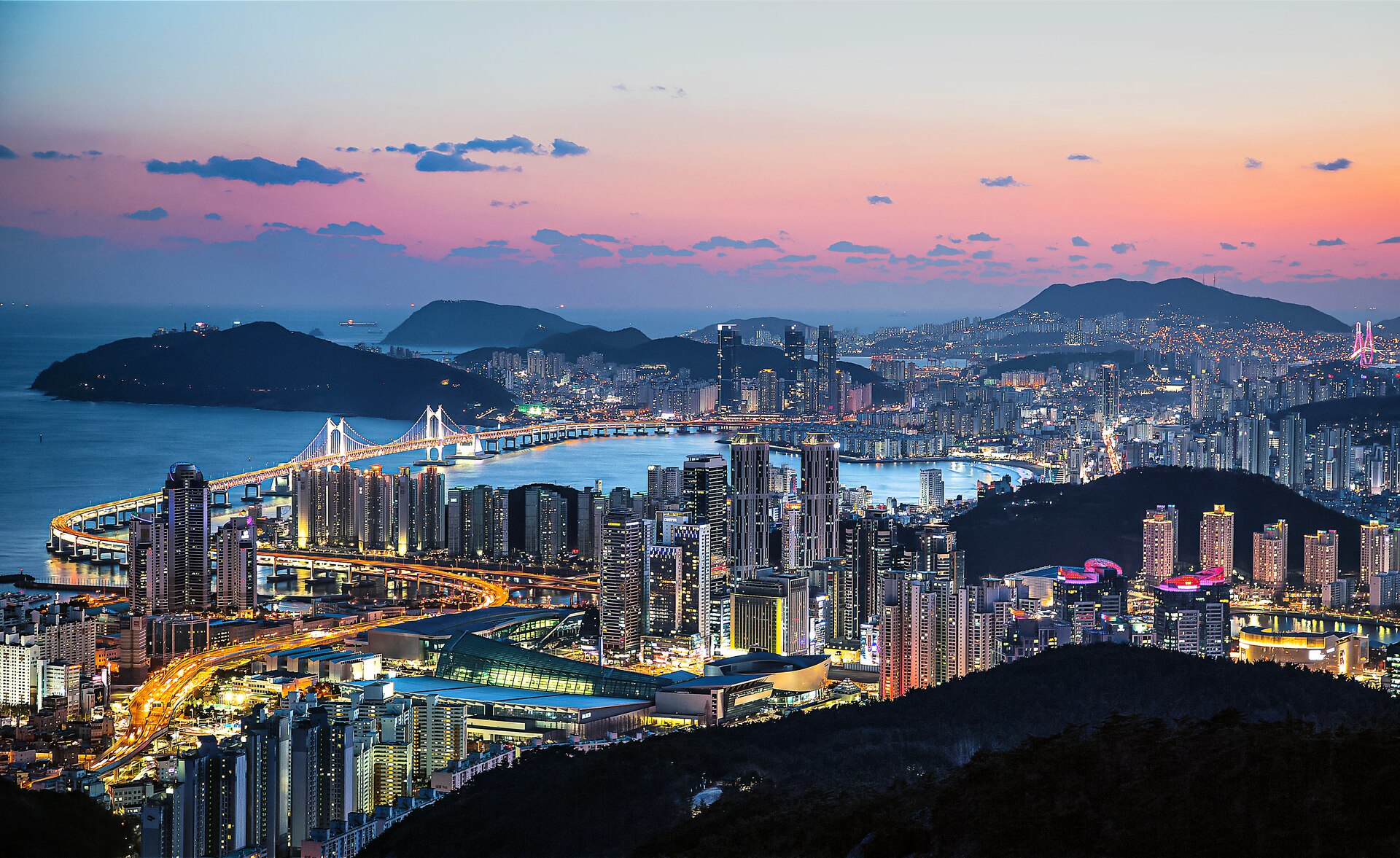
Busan is the second-largest city in South Korea, a port city on the southeastern coast known for its beaches, seafood markets and hot-spring districts. For travellers from Clark the direct service makes it an easy, relaxed leisure destination.
FAQ
5 questions below draw only on the route, carrier and fare data this project keeps for CRK–PUS. Where a number is a cache floor it is described as one, and where a rule does not hold universally the gaps are spelled out.
Delays and cancellations: what actually applies on CRK–PUS
2 rulebooks cover CRK–PUS from the Philippine side: the Civil Aeronautics Board’s Air Passenger Bill of Rights, which governs the departure from a Philippine airport, and the Montreal Convention 1999, which caps liability for delay and baggage. South Korea may operate its own scheme for departures from its airports; this page does not track it.
None of the statutory compensation schemes this site sources — EU261, UK261, the Saudi GACA regulation, Canada’s APPR and the US DOT consumer rules — reaches CRK–PUS. Read that as a statement about our source list, not as a finding that South Korea has no rules of its own: states routinely regulate departures from their own airports, and the civil aviation authority of South Korea is the body to check before you conclude that nothing applies. What definitely does apply in both directions is the Montreal Convention 1999, which caps a carrier’s liability for delay and for baggage that is damaged, delayed or lost. Montreal reimburses proven loss up to a cap; it pays no fixed sum for the inconvenience itself, so keep receipts rather than counting hours.
On the Manila end, a flight departing a Philippine airport is covered by the Air Passenger Bill of Rights administered by the Civil Aeronautics Board, which obliges the carrier to offer rebooking or a refund and to provide amenities as a delay lengthens. Its shape matters: refunds and service obligations, not a tariff of cash compensation — do not plan a claim around a fixed sum.
Can I claim delay compensation on CRK–PUS? Not under any scheme this site sources. The fallback is the carrier’s conditions of carriage plus Montreal Convention 1999 liability limits, and South Korea’s own civil aviation authority is worth checking for departures from its airports. Separately, a departure from a Philippine airport is covered by the Civil Aeronautics Board’s Air Passenger Bill of Rights, which mandates rebooking, refunds and amenities but sets no fixed cash scale.
Which airlines fly from Clark to Busan? Jin Air flies Clark to Busan, with around 4 departures a week.
How long is the flight from Clark to Busan? Nonstop block time is about 4.0 hours.
When are Clark to Busan fares cheapest? Fares on CRK-PUS are quoted in PHP and move with demand. They climb around the December holidays and Holy Week. Booking four to eight weeks ahead usually secures a reasonable economy fare.
Are there nonstop flights from Clark to Busan? Yes — Clark to Busan is flown nonstop. Booking early still helps, as seats on the cheapest fare classes sell first.
Search live fares
Search CRK → PUS on Aviasales →
Related
Where to stay · Busan
Hotels in Busan — peso budget
Budget
Hostels & 2-3★
₱1.5–3k / night
Mid-range
3-4★ comfort
₱3–7k / night
Luxury
5★ & resorts
₱7k+ / night
Hotellook compares 70+ booking sites incl. Booking.com, Agoda, Trip.com — booking earns us a small commission, kabayan.
All hotels in Busan